
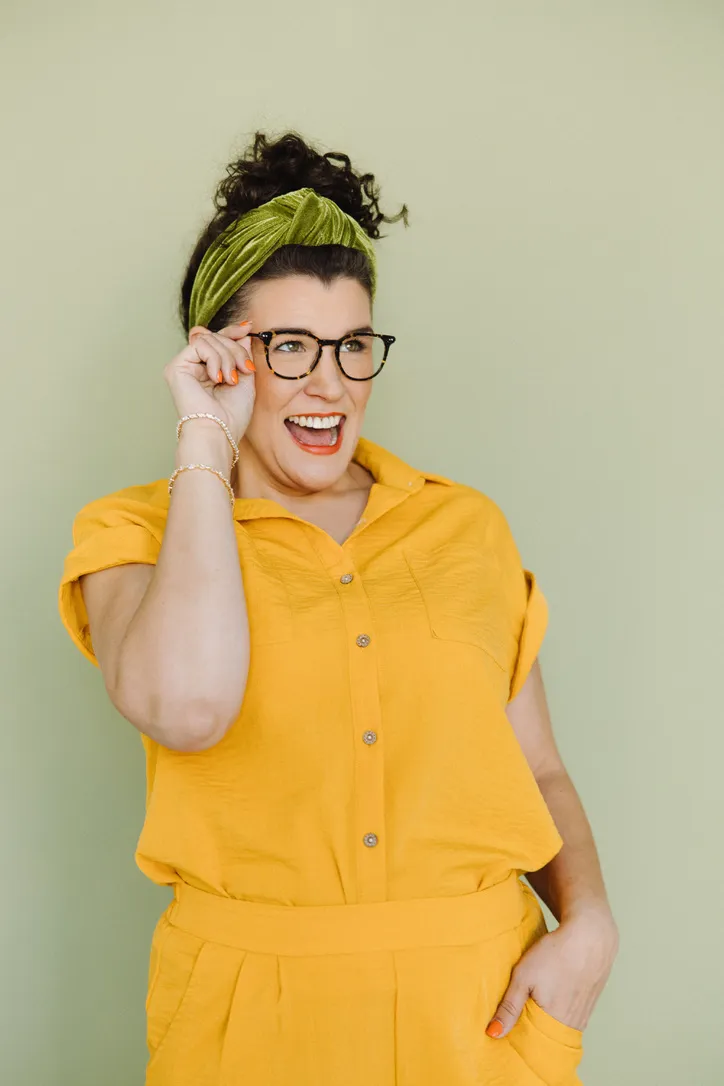
IWhy I became a therapist
I grew up in a family where untreated stuff was the air everyone breathed. Multiple generations of pain that nobody ever got the language for. Anger that did not know it was grief. Grief that did not know it was inherited. A dad who could make a stranger furious in five minutes flat at a family vaycay hotel check-in — like, world-record speed, you could time it. A mom who projected warmth and carried a lot underneath. A sister who was struggling more than anyone could name out loud.
I was the family translator. The peacekeeper. The kid who learned to read a room before she could read a book. There is a whole generation of women doing this same job in their own families right now, and most of them have no idea they were trained for it.
At restaurants I was the wheel-greaser — the kid who apologized to the waitress on the family's behalf. At home, I was running a loop nobody named out loud: managing my dad. Then managing my mom managing my dad. Then managing my mom managing my sister. I was the one whose job it was to feel everyone's feelings carefully enough that the room would not implode.
I had not yet figured out that this was the job I had been given. I was just a kid who knew, the way kids know, that one of us had to be paying attention.
I have dyslexia. School was its own kind of hard, in a way that mostly meant I could feel my brain getting tired before lunch. Math and spelling made me have actual panic attacks as a child. (My five-year-old, who I am raising in a family lineage of neurospicy people, is currently loving math and spelling. That is a sentence I do not take for granted.)
At eight, I wanted to be a teacher. At fifteen, I wanted to help people. At twenty-two, I was in grad school becoming a therapist. The line is straight. I do not think I ever seriously considered another path.
What I trained in, and what I taught for thirteen years
My first job out of grad school was building psychoeducational group curriculum for teens with depression and the parallel curriculum for their parents and then running the groups. I was new. I had no business doing it. I did it anyway. Which is to say: what I do now is what I did then. I just have a better foundation under it.
Then three months as a hospice social worker — hard, fast, formative, out. Then two years at an inpatient addiction treatment center, which is where I learned what severe mental illness actually looks like, what addiction actually is (a body trying to regulate its metabolism, mostly), how much compassion I have for that population, and how ugly the corporate underbelly of the inpatient treatment industry can be.
The trainings I saved up for were Pia Mellody's Post Induction Therapy at the Meadows (still the framework of how I see a person), EMDR, and IFS. I cross-pollinated all of it with Lisa Feldman Barrett to update the foundation. IFS Level 2 is next. Terry Real's Relational Life Therapy after that. Beatrice Chestnut's Enneagram work somewhere in there.
I am not deeply somatic in my practice. There is obviously a mind-body connection — I am not living in a brain in a jar over here, I have a body and it does things — and I do believe things can move through. But the binary version of store trauma in the tissues / release it through movement — which has become the dominant pitch in that space — has not held up for me. Affect is in the body. Emotion is constructed. The science is starting to back this up.
For most of those thirteen years, I taught my clients what I had been trained to teach them — boundaries, self-compassion, inner child, window of tolerance. I taught it well. I taught it with care. It was the best translation of the source material I had been handed.
And almost all of them, eventually, said some version of the same sentence to me:
Why is this so hard when I am trying so hard?
I would go home and think about it. Often.
Then I read the book
I read Lisa Feldman Barrett's How Emotions Are Made in 2024 — a year after my second baby was born, when I was ready to throw myself back into work, and out of dadgum integrity I wanted to see what new research had come out while I was off the grid with two precious rug rats. I expected a few new studies. Maybe a framework to fold into my existing one.
I got a foundation collapse.
Holy shit, girl.
The book made it impossible to keep teaching what I had been teaching. The entire foundation I had been building tools on top of — the classical theory of emotions, the idea that they are hardwired and universal and sitting inside us like little volcanoes waiting to erupt — is based on a Darwin study from 1872 and a handful of follow-ups in the 1970s that have not held up under modern testing.
(1872. The year. Yes. I checked.)
The current science says something completely different. Your body is not having emotions at you. It is constructing them, moment to moment, out of ingredients you can actually learn to see.
I spent the next year learning the science. Then I spent another year building the bridge — figuring out how to package what the science actually means so people can use it, in their actual lives, outside a therapy room.
That bridge is The Human Operating System.
To be clear: if your therapist is not working in this framework, that does not mean they are doing anything wrong. There is great therapy happening every day — right now, while you are reading this, in offices all over — by clinicians who are deeply committed to their work, without the predictive emotion lens. What bugs me is when the field is offered a serious update and chooses not to pick it up. The science is going to keep moving. The humility to keep moving with it is part of the job.
Why this lives outside therapy
Here is a thing about therapists that most people do not know.
I am a Licensed Clinical Social Worker. In Texas. Only. By law, I cannot be your therapist if you do not live in Texas. The licensure system is designed that way for reasons that are mostly good — but it has a side effect, which is that the women who need what I built the most are mostly outside my reach as a therapist. I also have a waitlist a mile long.
There are also not enough licensed therapists in the country to teach this one-on-one to the number of women who need it. The math does not work. I have done it on a napkin. There is no version of "everyone gets their own clinician" that scales.
So I made the education piece into a course.
I want to name something else about the women I am building this for. In the last five years, the clients finding their way to me have mostly been mothers. High-functioning. Doing well by every external measure. Quietly lonely. Coming in asking about friendships and conflict, carrying way more underneath than they are allowed to admit. After becoming a mother myself — which is the kind of life event that rearranges your furniture without asking — I see them differently than I used to.
I see the bind they are in that nobody is naming — their own body budget.
We sold these women a story about motherhood that was supposed to feel fun and easy. The reality is that they are operating with less internal capacity than they have ever had in their lives, and they have been told it is a character flaw. It is not. It is a body budget problem. And it is also a structural problem, because the conditions women are mothering inside — who earns, who is the default parent, what role they got locked into in their family of origin — those conditions shape the nervous system as much as any childhood wound does.
This is what The Human Operating System teaches. The body budget. The structural conditions. The framework for understanding what is actually happening to you.
It is not therapy. It is the foundation that therapy was always supposed to be built on.